My reflections on leadership continue.
Find purpose
Purpose, a feeling of meaning, is essential for our wellbeing and feeling happy with our life. You should find a purpose to be the best version of yourself. For some, leading others towards growth is the purpose of making it all worthwhile. However, your leadership doesn’t have to be your life’s purpose; it can be anything but find purpose with your life and in your life. Furthermore, find meaning in your leadership. When we find meaning, our efforts and energy will multiply due to the passion meaningfulness brings. Spend time to contemplate and map out your purpose, both in life and in your leadership. With that as a base to navigate from, you will be happier and a better leader.

Find your purpose. Be visionary, balance your act and stay true.
Be authentic
Entering into a role of leadership will, without a fault, carry with it new challenges. Some of which might not have a clear solution, and you will be taken out of the comfort zone. Some are dreading conflict management, and others are blushing to death when presenting the quarterly budget. You probably have heard fake it until you make it; this mindset can help us in uncomfortable situations and spark us to dare, i.e., you do know more than you know. However, I don’t believe it will work in the end with everyone. People will see through the façade if you aren’t authentic. This advice is not saying you shouldn’t learn new things, develop or strengthen your abilities, or avoid uncomfortable situations. It’s quite the opposite. It is about authenticity. Being authentic is about acknowledging your strengths as well as areas you can improve. Being genuine will grant you loyalty and connection with the ones you lead. Be open about your challenges. Be vulnerable, be strong, be yourself. I encourage you to spend some time to find out more about yourself as a person and leader. There are myriads of courses and literature for this, and it might suffice for you to take time and ponder yourself. What makes you frustrated? What is most fun or rewarding? How do you react to people who don’t resonate well with you? Authenticity will carry you in your leadership, your relationships, and your personal growth.
The department was struggling, and Angela didn’t know what to do. Her being the manager, she assumed it was her responsibility to inspire. The former manager had been very talented at rallying everyone with positive talks. Being an ambitious and professional leader, Angela planned for an inspirational speech during the next department meeting. Having no rhetorical training and public speaking, she feared more than death; it did not go well. The awkward silence stayed with Angela for a long time. She decided to take a public speaking course while pondering other strategies to turn the ship around.
“Authenticity is the daily practice of letting go of who we think we’re supposed to be and embracing who we are.”
Brené Brown
Embrace authenticity in your leadership. Be visionary, balance your act and stay true.
Leadership habitat
The surgeon cannot work unless the tools are in order and the table sterile. In many professions, the environment, or habitat, is as big a part of the job as any other component. If the habitat is not ordered to your advantage, the quality of work will be poor. We can all benefit from giving our habitat more thought, and it is vital for the leader. The habitat is not only the ‘things’ in your immediate surroundings. It is the planning, preparation, and strategic use of energy.
- Do you take on the most difficult tasks when your energy levels are on top?
- Are you using adequate tools to organize your work?
- How are you prioritizing your health?
- Is your physical work-place in order?
Sanjay was stressed, sitting in his office trying to get his mind and his desk in order. Swamped with tasks for weeks, and a major interpersonal conflict was waiting for him to solve. His to-do-list was a novel by now; he couldn’t seem to prioritize. He realized the usual boost of coffee and chocolate wouldn’t do the trick. Instead, Sanjay called his mentor and booked a long-overdue meeting at a nearby café. Afterward, Sanjay held a note in his hand with three pieces of advice. First, get moving. To incorporate active breaks during the day and suggest walk-and-talk meetings. Second, one-point lists. To not work from a long to-do-list in front of him draining an already tired mind. Instead, he would put one task on a post-it and work with it until completion. He would then write another task from the main list to a one-point note. Third, recharge. Find ways to increase the energy levels; Sanjay prioritized sleep and play-time with his daughter.
Give yourself preconditions to be a great leader. Even small changes can enhance your efficacy. Optimize your leadership habitat by first looking at what your job is. What are the goals of your department, and what is your role in achieving them? Far too many times, managers get stuck in a solely administrative position with no room for authentic leadership.
Get your habitat in order. Be visionary, balance your act and stay true.
Strategic mindset
Katherine was sitting with the project group discussing the proper way forward. It was a big project, and she was the appointed project leader, a massive opportunity for her. However, the group was stuck; for some reason, they couldn’t find a bridge from the initial planning phase to phase one of the operations. Opinions and suggestions blew around the table yet never reaching the eye of the storm. While looking at the bustling street outside, Katherine thought of her thesis in political science. She got up and walked to the whiteboard while the room being silent. Katherine wrote three words on the board: Why? What? How?
The core of a strategic mindset is simple, to connect the why, what, and how. By incorporating this mindset could make many good leaders great. Like Katherine, we should turn to academia and the conducting of research. You have to state a purpose (why). Connected to the purpose, you form a goal or research question (what). The method (how) then used always has to be derived from the purpose and research question. Otherwise, we are not sure we are answering our set out research question. If we don’t choose the correct map, we will not end up where we aspire to travel.
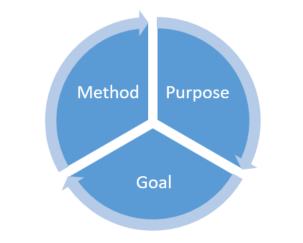
The strategic mindset is not only valuable in large projects or big decision making. It plays a crucial role in the everyday being of a leader. Whether it’s conflict management, solving work schedule hiccups, or budget negotiations. By connecting the purpose, goal, and method, we find we are doing more of the right thing, and most importantly, we stop doing the wrong things.
Incorporate a strategic mindset and ask yourself; Why? What? How? Be visionary, balance your act and stay true.
Until next time
 Reflections of a grain